
January 12, 2026
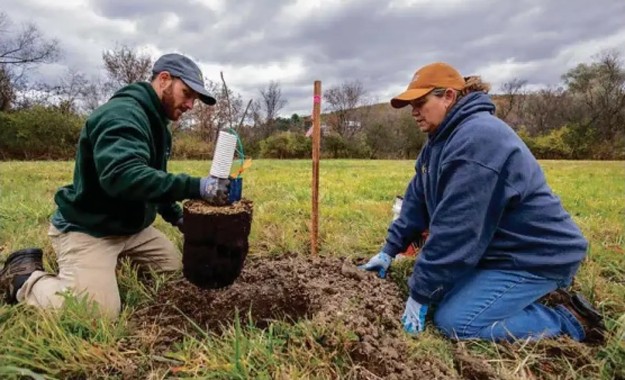
Yesterday’s local newspaper carried a USA Today article on a project designed to restore native ash populations to the state of New York. The ash saplings planted at Cornell Botanic Gardens as part of the Nature Conservancy’s Trees in Peril project are part of an effort to restore the disappearing species. Ash has long been valued for its lumber and is used in baseball bats, tool handles, flooring, and fireplaces. The invasive species attacking the trees was first discovered by entomologist Mike Griggs on Cornell University’s campus, as tree canopy dieback, yellowing and browning of leaves. The condition had spread farther west in the state in 2009, and quarantine zones were established in 2015 to block the spread. According to the NY State Department of Environmental Conservation, the emerald ash borer has killed millions of trees across the US, caused billions of dollars in damage and loss, and overtaken virtually all of New York state.
When I went online, I found the emerald ash borer (Agrilus planipennis), or EAB, is a green jewel beetle (buprestid) native to north-eastern Asia that feeds on ash species (Fraxinus spp.). Adult beetles are typically bright metallic green and about 0.33 inches (8.5 mm) long and 0.063 inches (1.6 mm) wide. Emerald ash borer is the only North American species of Agrilus with a bright red upper abdomen when its wings are spread. The species has a small spine at the tip of the abdomen, and saw-like (serrate) antennae that begins at the fourth antennal segment. Females lay eggs in bark crevices on ash trees and the larvae feed underneath the bark to emerge as adults in one to two years. The ash borer is typically found at low densities in its native range and does not cause significant damage to trees but is a highly destructive invasive species to the ash trees of Europe and North America. Adults prefer to lay eggs in stressed ash but readily lay eggs in healthy trees among other tree species. Little was known of the ash borer before it was found in North America.
Local governments are attempting to control the ash borer by monitoring its spread, diversifying tree species, and using insecticides and biological control. A significant discovery was made by the US Forest Service when they found relatively healthy trees amidst a forest of dead trees. The surviving trees, called lingering ash, could serve as a catalyst for repopulating ash populations across the US. The ash borer larvae tunnel through the living tissue and with 100’s of 1000’s of insects in each tree can essential girdle the tree making it impossible to transport resources between the canopy and roots. Researchers found some lingering ash can “wall off” the larvae and prevent the insects from girdling the tree. A second possible defense is related to the organic compounds emitted by ash trees during photosynthesis and used by the ash borer to detect the trees. If an individual tree does not produce those chemicals or does so at low levels, the tree becomes “invisible” to the insects. The goal of the project is to propagate 50 to 60 genotypes of trees of each of the three ash species (white, green, and black). In 5 to 6 years cuttings (scions) will be collected and the process repeated. The lingering ash will then be planted among susceptible trees to restore ash to the forest environment.
THOUGHTS: The Emerald Ash Borer likely arrived in North America from Asia in the 1990’s hidden in solid wood packing materials (crates and pallets) used in cargo ships. Detection in the US was in Michigan in 2002. This accidental introduction allowed the invasive beetle to spread rapidly, killing millions of ash trees. Movement of infested firewood by humans accelerated its spread across the continent. The predators and diseases that naturally keep the ash borer in check do not exist in North America. Developing the lingering ash would be a significant check on yet another invasive species. Otherwise, Major League Baseball will be forced to use aluminum bats. Act for all. Change is coming and it starts with you.
 A travelers odyssey