
May 17, 2026
I try to put a variety of seeds in the 11 feeders we have on our pool deck. I purposefully dedicated the two farthest feeders under the trees to the eastern gray squirrels (Sciurus carolinensis). I put shelled peanuts (Arachis hypogaea) and a corn (Aea mays) log in one and cracked corn in the other. I did this as it was a losing battle to try and keep the squirrels out of all the feeders. I found the northern cardinals (Cardinalis cardinalis) and common grackles (Quiscalus quiscula) prefer these feeders, while the squirrels run along the fence to feast on the two feeders with common sunflower (Helianthus annuus) seed on the other side of the deck. I have also stocked meal worms (larva of Tenebrio molitor), two feeders with roasted peanut chips, and a wild bird seed mix (cereal grains of Family, Poaceae). I currently stock the two window feeders with safflower (Carthamus tinctorius) seed, but this is messy and I am considering switching back to sunflower chips. The last feeder is a suet corn cake. While most of the birds which visit are the same every day, we do get an occasional new species. Last week the new arrival was a Baltimore oriole.
When I went online, I found The Baltimore oriole (Icterus galbula) is a small blackbird of the icterus family common in eastern North America as a migratory breeding bird. The species was formally described in 1758 by the Swedish naturalist Carl Linnaeus in the tenth edition of his Systema Naturae under the binomial name Coracias galbula. The bird received its name from the resemblance of the male’s colors to those on the coat-of-arms of 17th-century English Baron Lord Baltimore. There have been observations of interbreeding between the Baltimore oriole and the western Bullock’s oriole (Icterus bullockii) which led to both being classified as a single species, called the northern oriole, from 1973 to 1995. Research by James Rising, a professor of zoology at the University of Toronto, and others showed that the two birds did not interbreed significantly and they are again classified as different species. The Baltimore Oriole is the state bird of Maryland, and the namesake and mascot for the Baltimore Orioles baseball team.
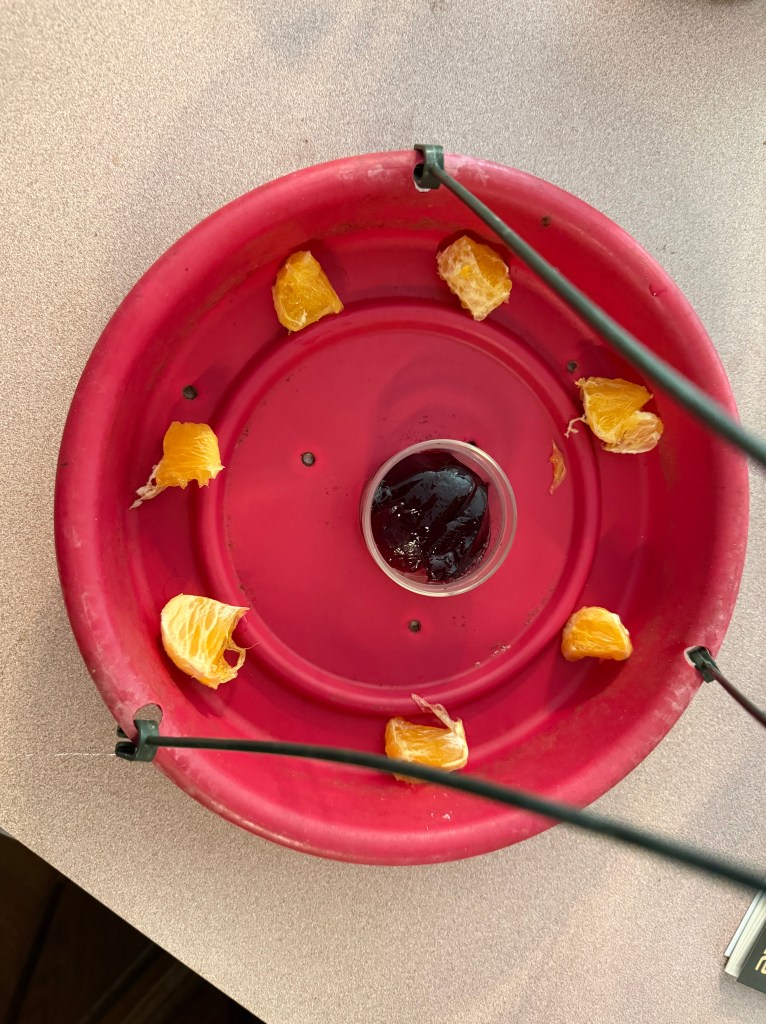
Melissa has a friend who has been texting her pictures of an oriole who has been visiting her feeder. She put out a tray with orange (Citrus sinensis) slices and grape jelly, and they clean her out several times a day. We have only seen the oriole twice on the suet cake, but I figured we might get more activity with orange slices and grape jelly. A number of other birds (and squirrels) are fond of oranges so this may bring other birds as well. I followed the friend’s example and initially set the feeder next to the suet cake, but the grackles pounced on the feeder looking for the peanut chips and knocked it to the ground. This afternoon I set the oriole feeder back up and moved it farther away from the others. Hopefully this will work and attract an oriole before they migrate through our area.
THOUGHTS: When I was growing up in north central Kansas there was a Baltimore oriole that would nest in the branches of a tree outside my second story window. This was a massive American elm tree (Ulmus americana) that stretched over the enclosed side porch. I was fascinated by the bird and its flashy orange and black body. I was also into collecting baseball cards and listening to my older brother’s radio playing baseball as we fell asleep at night. I became a huge fan of the Orioles (team) in part because of my connection to the bird outside my window, along with the fact they became an American League powerhouse in the 1960’s, wining two pennants and their first World Series. Although I now (mostly) follow the Kansas City Royals baseball team, I still have a fond spot for the Orioles. Most of our traditions and habits were ingrained in us during our youth. That is why it is important to train a child to be willing to reach out and embrace others. Act for all. Change is coming and it starts with you.
 A travelers odyssey