
October 19, 2026
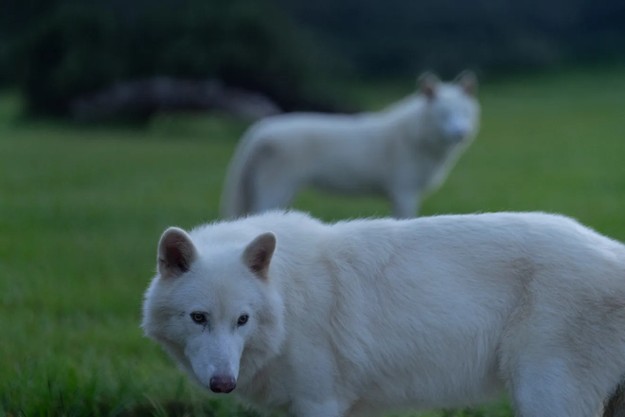
Inside the front section of today’s newspaper was a USA Today article about the second birthday of genetically engineered wolves. Romulus and Remus were born in October 2024, and recent checkups indicate they are both healthy and full-grown. Romulus, the larger wolf, weighs 134 pounds (60.8kg), while Remus weighs 132 pounds (60kg). Each measure nearly seven feet (2 m) from nose to tail. Their slightly small sister, Khaleesi, is a 1-1/2-year-old female engineered wolf named after the character in the Game of Thrones novels. Born nearly four months after her brothers, Khaleesi weighed in at 102 pounds at her own recent checkup. The update comes from Colossal Laboratories & Biosciences, the biotech company that made a splash by proclaiming in 2021 its plans to bring back the woolly mammoth (Mammuthus primigenius). Colossal researchers edited the gray wolf genome to express specific traits of the dire wolf, a North American predator that roamed for thousands of years before going extinct. Fertilized dire wolf eggs were implanted in and born by surrogate dog mothers on October 1, 2024. Colossal announced the existence of the dire wolves April 2025 and the three live in a 2,000-acre preserve and have developed into a pack.
When I went online, I found the dire wolf (Aenocyon dirus) is an extinct species of canine native to the Americas during the Late Pleistocene and Early Holocene epochs (125,000 to 10,000 years ago). The largest collection of dire wolf fossils has been obtained from the Rancho La Brea Tar Pits in Los Angeles, US. Remains have been found across a broad range of habitats including plains, grasslands, and forested mountain areas of North America and the arid savanna of South America. The wolf was about the size as the largest modern gray wolf (Canis lupus). The species averaged 132 pounds (60 kg) to 150 pounds (68 kg). Its skull and dentition matched those of the extant gray wolf, but its teeth were larger, had a greater shearing ability, and its bite force was stronger than known Canis species. These characteristics are thought to be adaptations for preying on Late Pleistocene megaherbivores. Extinction occurred along with the disappearance of the megaherbivores 10,000 years ago.
Prior to the dire wolf, the process of de-extinction met with failed attempts to bring back the Pyrenean ibex (Capra pyrenaica pyrenaica) in 2009 and the 2003 cloning of a banteng (Bos javanicus), a wild bovine from Java. Matt James, Colossal’s chief animal officer said, “There’s typically been questions around what is the health impact to the animal, so, for us to be able to say not only two years ago did we bring a species back from extinction, but two years on, we’re really excited … from a health perspective, they’re in great condition.” Colossal points to the healthy dire wolves as evidence that its biogenetic engineering processes work. In addition to the wooly mammoth, the company has de-extinction projects for the dodo (Raphus cucullatus), the Tasmanian tiger (Thylacinus cynocephalus), the giant moa (Dinornis novaezealandiae), and an African antelope known as the bluebuck (Hippotragus leucophaeus).
Thoughts: The advances that produced the dire wolf are expected to benefit Colossal’s projects to preserve existing endangered species. “I think the dire wolves provide us with an amazing use case that we can demonstrate the long-term effects and consequences of genetic editing and cloning as a tool for conservation biology”, James said. De-extinction is a promising tool that can reestablish threatened and extinct species. However, there are reasons they went extinct in the first place. If we fail to address the destruction of ecosystems, we risk recreating a species only to kill it off one more time. Then again, has anyone ever watched Jurassic Park? Act for all. Change is coming and it starts with you.

