
November 14, 2026
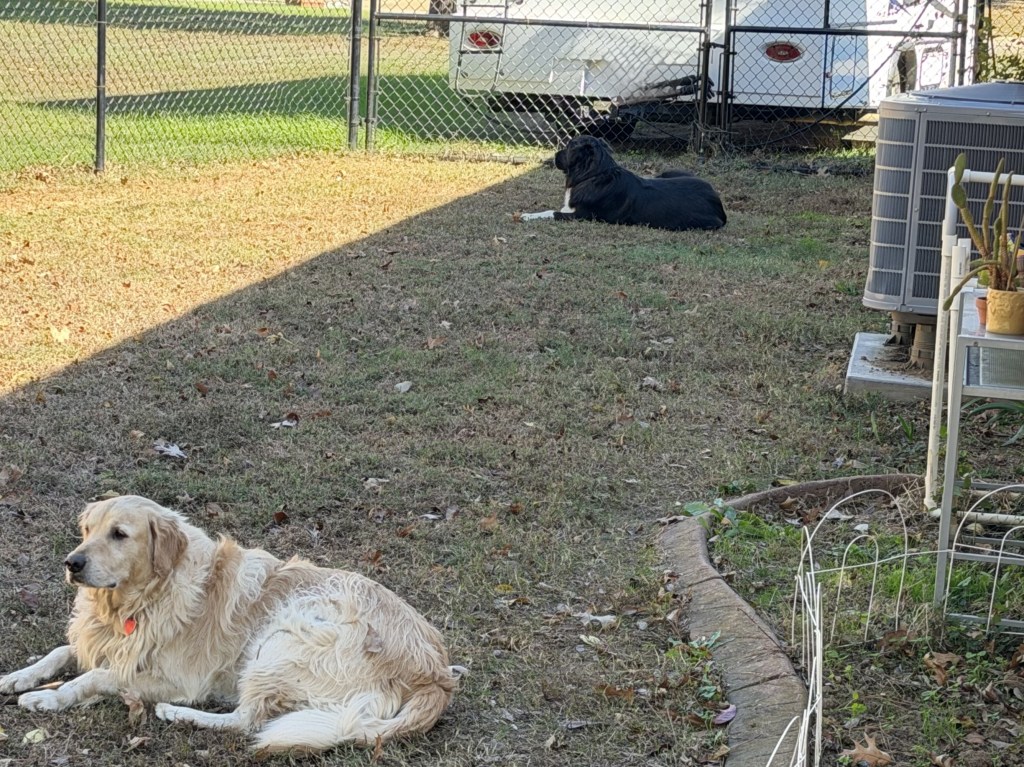
I have mentioned our dog Zena is a Great Pyrenees and Loki is a Golden Retriever (both Canis lupus familiaris). The first thing they both do when I let them out the back door is run to the fence to see if there are any trespassers. This refers to one of the eastern gray squirrels (Sciurus carolinensis) that skitter along the top of the fence to access the bird feeders. While the raccoons (Procyon lotor) have not been back, I still bring in the window feeders at night as a precaution. Several nights ago, there was a young Virginia opossum (Didelphis virginiana) taking advantage of the bounty of my feeders that they trapped on the fence. Now that the weather has cooled, the kids want to spend more time outside on their own. After checking the back fence Zena will immediately go on patrol, pacing along the exterior of the fence several times before settling down. I often later find Zena sitting at the front of the fence keeping watch of our cul-de-sac. Eventually she will settle down enough to move back along the side of the house and lay down, although her head is still raised and her eyes tracking any movement. The Golden is not known as a watch dog as they are too friendly, but they do tend to alert you of a foreign presence. In contrast, Pyrenees are excellent guard dogs, particularly for livestock, property, and home steads.
When I went online, I found what makes the Pyrenees a good guard dog. This begins with their breeding. The dogs were used for thousands of years in the Pyrenees Mountains to protect sheep from wolves and bears without human instruction. They make decisions on their own and do not require constant supervision. They are also massive as adults, typically weighing 85 to 140 pounds (38.5 to 63.5 kg) with a deep, booming bark that they use frequently at night to warn off predators like coyotes, bobcats, and bears. The breed is naturally most active at dusk, dawn, and through the night, constantly patrolling and scent-marking their territory. Despite their fierce capability against predators, they are famously patient, calm, and gentle with family members, children, and smaller animals they consider part of their “pack”. Pyrenees are not “attack dogs” but will stand between their owner or livestock and a threat. Their instinct to guard means they bark at any perceived disturbance (often at night) and have a strong tendency to roam or try to escape standard fencing to expand their patrol territory.
While Loki may not be a guard dog, he does tend to imitate Zena. Loki will also patrol the fence looking for intruders and when Zena lays down Loki will lay near her and keep watch. The two often play off one another. If Loki detects a sound he will bark in recognition and Zena will give an immediate “warning bark” to tell the noise to stay away. This noise could be anything as nefarious as the wind. Zena also sits in the dining room window and protects the cul-de-sac from cars or walkers that stray into her perceived territory. The life of a guard dog is hard.
Thoughts: It is interesting to watch guard dog instinct that is inbred into Zena. Not long after we installed the fence the kids worked through the bottom of the gate and patrolled the neighborhood. When I found them, they were loping along the road making sure everything was safe. They were happy to see me and immediately jumped into the car when I called. Loki will often stand staring out the back windows to watch for the squirrels or wayward mice (Mus musculus) that hide under the door ramp and come out for the bird seed dropped from the feeders. However, being on guard and taking our daily walks are exhausting, and much of the kids’ day is spent sleeping (with one eye open of course). Humans are also instinctually wary as early humans evolved as prey species. This shaped deep-seated traits for caution, group cooperation, and scanning the environment for danger. Overcoming this mistrust is essential to society. Act for all. Change is coming and it starts with you.

