
June 05, 2025
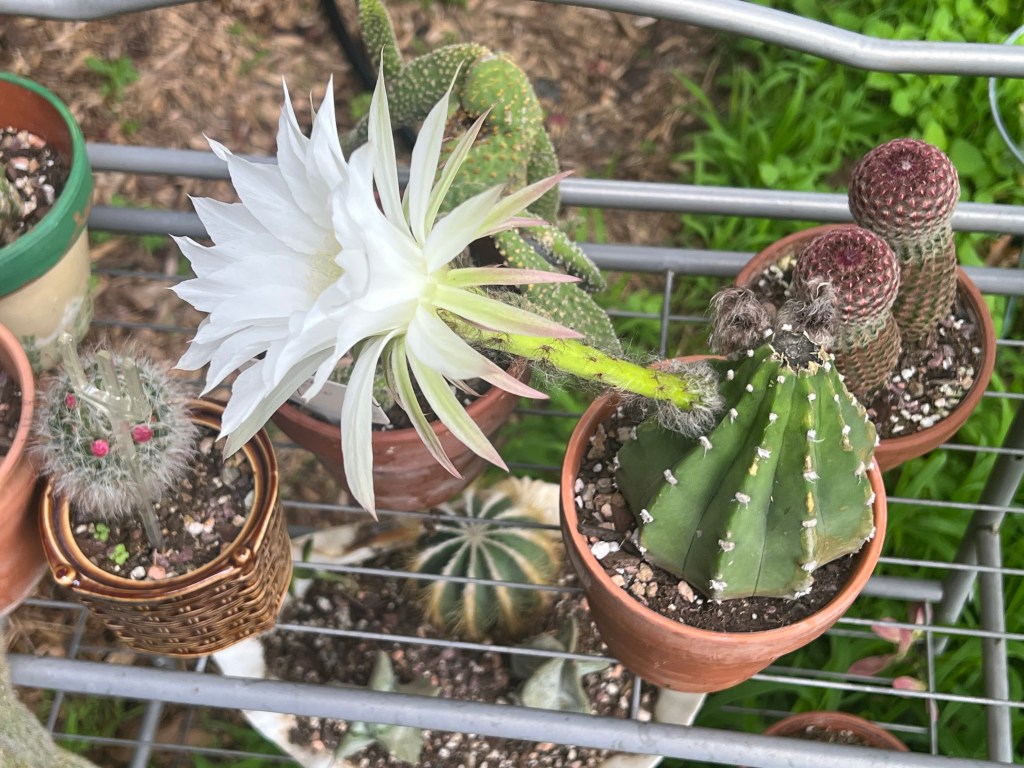
Yesterday morning Melissa asked me to come to the front porch and look at the beautiful flower that had sprung up overnight on one of her cacti. With warmer weather she has placed many of her summer growing cacti on shelves along the front entryway. This allows them to catch the early rays of sun and protects them from the rain we have been getting. I have mentioned how Melissa says one of the worst things you can do for a cactus is to water it. While they need moisture, if you over water it will cause root rot and kill the plant. This is one of melissa’s newer cactus and the first time it has bloomed. The domino cactus flower dwarfed the small globe of cactus it sprouted from.
When I went online, I found the domino cactus (Lobivia ancistrophora) has a globular shape, few spines, with large, white flowers attached to long, green tubes. The domiono is endemic (native) to Bolivia at altitudes of 1,968.5 to 5,905.5 feet (600 to 1800 m). It has gained the Royal Horticultural Society’s Award of Garden Merit under the synonym Echinopsis ancistrophora. The domino has a single spherical shaped grey-green body, slightly depressed at the top. The plant grows to heights of 2 to 3 inches (5 to 8 cm) with diameters of 2.7 to 4.7 inches (7 to 12 cm). It has 10 to 12 straight, sharp ribs with small, cream-colored, elongated-elliptical bumps (areoles) that are 1/2 inch (1.5 cm) apart. The small thorns are grayish brown and often hidden in the areole wool. The upright central spine is again small (2 mm) with 3 to 7 tiny 1.5 mm) thorns at the base. The narrow funnel shaped flowers are white to light pink and slightly curved above the ovary, are 6.5 to 7.8 inches (17 to 20 cm) long. They appear on the side near the top of the shoot and open at night. The pale green flower tube is up to 5 inches (15 cm) long. Its purple scales are pointed with long white and black hairs. The flower blooms at night and then closes during the day.
The domino cactus is one of the many cacti that are night bloomers. The night bloom is primarily to facilitate pollination by nocturnal creatures and to conserve water. These cacti have evolved to attract pollinators which are active at night, like bats and moths. Since the habitat where they thrive is cooler and more humid at night, a night bloom reduces water loss through evaporation from the plant’s leaves and flowers (transpiration). The timing of cactus blooms is also part of a broader adaptation known as a pollination syndrome, where plants co-evolve with their primary pollinators to maximize pollination efficiency. Melissa’s domino cactus is continuing its genetic predisposition. While we do not have a lot of bats swooshing through our front porch, there are a lot of moths which could facilitate pollination.
THOUGHTS: The domino cactus is not native to the desert of Southeast Utah, but pollinating bats are plentiful. My son and I used to camp by rolling our bedrolls out on the slickrock above the wadi beds. Although the sand may have been softer, the rock got you above any possible flash flood from a rain 20 miles upstream. One of my memories was listening to the swishing sound as the bats zipped through the air in search of insects. I never saw a bat in the dark, but the sound of their wings was unmistakable. Many desert plants have adapted to produce bright showy flowers, and a number of those produce a strong aroma, to attract pollinators. Different environments have created selective ecosystems that have adapted to their conditions. When humans interject new species or radically change the environment it can have devastating effects. Some species will survive by adapting to the new environmental conditions, but many will either lose out to competition from the invasive species or die from lack of suitable habitat. While change itself is inevitable, forcing change from artificially created human conditions is rarely good for an existing ecosystem. Eventually however, mother nature wins, and often in surprising ways. Act for all. Change is coming and it starts with you.
 A travelers odyssey