
June 24, 2025
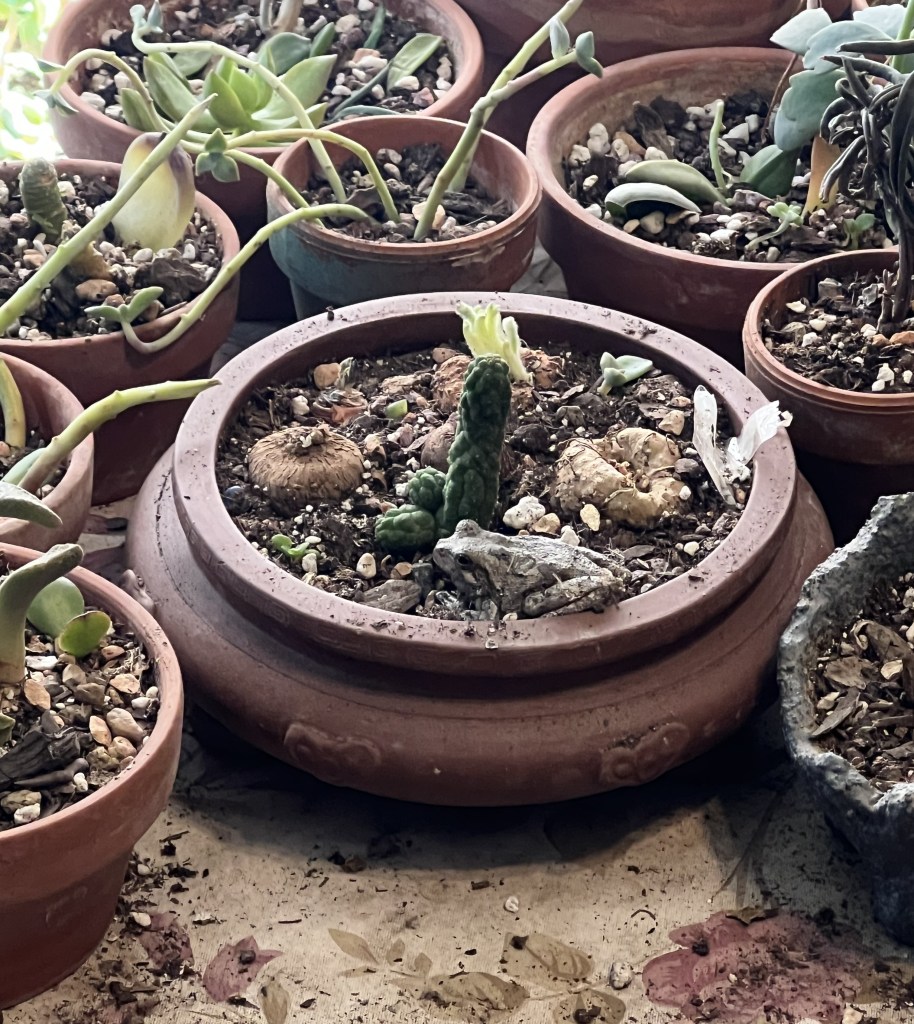
Earlier this week Melissa called me into the kitchen to take care of a “problem” she had found while working on her succulents. Our pool/pond on the back patio has been teeming with grey tree frogs (Dryophytes versicolor) caught in the height of mating season. This has resulted in successive scores of tadpoles that grow up to be adults. I often see one of the small frogs hopping across the straw mulch that covers the potato plants as I am watering. The frogs also like to hide behind the cushions on the Adirondack chairs on the patio. It appeared one of the larger adult frogs was not content hiding on the patio or in the American elm (Ulmus americana) trees that line the back property line and had decided to take up residence in the “jungle” of succulents Melissa was working with on the kitchen table. Melissa does not like hoppy things and called on me to remove it. I thought it was interesting and snapped a photo before grabbing the frog and releasing it over our back fence (away from the kids). It was not until I later looked at the photo that I realized the frog had been hiding next to a cactus barrel that appeared to have a bloom on its top.
When I went online, I found Cactus Barrel Milkweed (Larryleachia cactiformis), is a small perennial stem succulent with a globular body displaying a pattern of repeated shapes or polygons (tessellate) with either five pointed (pentangular), flat, or depressed projections (tubercles) on the surface. The species can vary greatly, particularly in the color of flowers, which open in the summer. The cactus barrel is native to South Africa and Namibia and grows at an altitude of a half to one mile (800 to 1600 m) above sea level. It is found amongst a belt of natural shrubland (Fynbos) and desert (Succulent Karoo) vegetation on the quartz hills of the Kamiesberge mountain range. The species is highly succulent (juicy) and adapted to the very harsh and bright habitats of the desert. The plant is an excellent example of convergent evolution and is easily mistaken for a cactus. It is widespread and the Red List of Threatened Species from the International Union for Conservation of Nature says it is common and not threatened.
One of my apps first misidentified my photo of the cactus barrel as a candelabra cactus (Euphorbia lactea). This made sense as when I looked at the photo there appeared to be a yellow flame coming out of the top of the succulent. When I mentioned this to Melissa, she pointed out the yellow bloom was on a low-lying elephant’s foot (Dioscorea elephantipes) succulent behind the cactus barrel. Melissa had placed four different types of elephant’s foot in the bowl, and said the only way to tell the difference (even for most botanists) was by the color and shape of the bloom. My flaming candelabra was an optical illusion formed by the angle from which I took the photo. I obviously have a long way to go when it comes to succulent identification.
THOUGHTS: The cactus barrel milkweed succulent is like other members of the Apocynaceae genus in its difficulty for cultivation. Propagation is a problem as the plant does not offset or seed readily and grows difficultly and slowly from seedling. Melissa has had this small specimen for two years and it has yet to flower (despite my declaration). Humans can also find it hard to propagate (spread) and are easy to be misidentified. When we say other newcomers “all look alike” we lump individuals into categories that may not define their true nature. We need to wait and take time to see what flowers (fruits) they produce to understand and accept them. Act for all. Change is coming and it starts with you.
 A travelers odyssey