
April 12, 2026
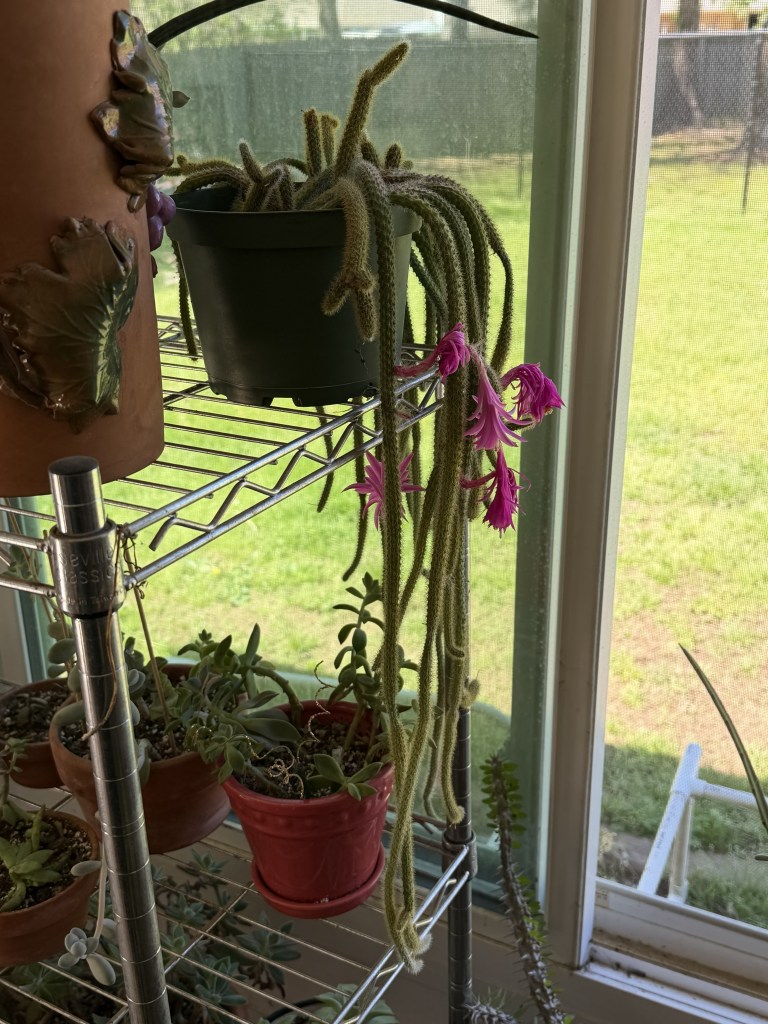
Traveling 5 of 6 weeks in February and March not only got me behind getting my garden in the ground but also in Melissa’s care for her succulents. The good news is even with the 100’s of plants Melissa tends for she only needs to pay attention to about half of them at a time. Different succulents grow at different rates within a year depending on the temperature, with some becoming dormant and growing slower when the weather is too hot or too cold and turn active again when the temperatures are ideal for their growth. That is why succulents are known as “opportunistic growers”. Succulents can be put into categories as either summer or winter growers. Summer growers thrive in the hot months of summer (May to August) and are dormant in the winter, while winter growers thrive in the cold of winter (November to February) and are dormant in the summer. The primary care given to all of Melissa’s succulents is an occasional misting during dormancy and scant watering and careful observation and maintenance during growing season. When Melissa was able to get back at tending her succulents last week, she called me out to look at the blooms on her rattail cactus.
When I went online, I found the rattail cactus (Aporocactus flagelliformis) is a species of flowering plant in the cactus family Cactaceae. With its ease of cultivation and attractive floral displays it is often grown as an ornamental potted plant. The Latin specific epithet (flagelliformis) means “shaped like a whip”, in reference to the plant’s long stems. The common name “rattail” refers to the same feature. The species was one of the first cacti to be introduced into European culture. Watson (1898) offers the year 1690 but it was probably earlier. The species is native to the dry forests of the central Mexican state of Hidalgo north of Mexico City where it can grow naturally on rocks (lithophytic) or as rootless air plants (epiphytic) in the trees. Specimens are rare in nature and are seldom collected in the field. While rattail has always been one of the most popular cacti in cultivation, almost nothing is known about its natural habit. The rattail cactus is a recipient of the Royal Horticultural Society’s Award of Garden Merit.
Rattail cacti are easy to grow and are suitable for either a greenhouse or container, indoors or out. Plants need a minimum temperature of 43F (6C). They should be grown in bright, indirect light, in a rich potting mix. The best compost consists of 4 parts of sandy loam and 1 part of equal quantities of sand and crushed brick. Rattail should be repotted every other year because their soil tends to sour. However, that does not mean they will need a larger pot. Once the plants are established, compost should be kept moist from April to October, with less water required from November until March, or just enough to keep stems from dying back. In the winter, old or discolored stems may be cut out at the base to encourage new growth. The rattail on our sunporch obviously made it through the dormancy of winter and greeted us with cascading blooms upon our return.
THOUGHTS: Rattail cactus, like most cacti, are summer growers and settle into dormancy during the winter. There are nine species of the Schlumbergera genus of cacti native to the coastal mountains of southeastern Brazil which reverse this rhythm. These species are collectively called “Holliday” cactus, with annual blooms arriving between November and April (i.e., Thanksgiving cactus, Christmas cactus, or Easter cactus). This illustrates the diversity that exists in nature as plants and animals adapt to the specific conditions of different regions. Humans did the same, although less markedly so. We are (at least now) all the same species, only differentiated by the tools, clothes, and culture we use to adapt to our region. The main difference between all humanity is how we choose to differentiate ourselves from each other. Act for all. Change is coming and it starts with you.
 A travelers odyssey