
May 14, 2026
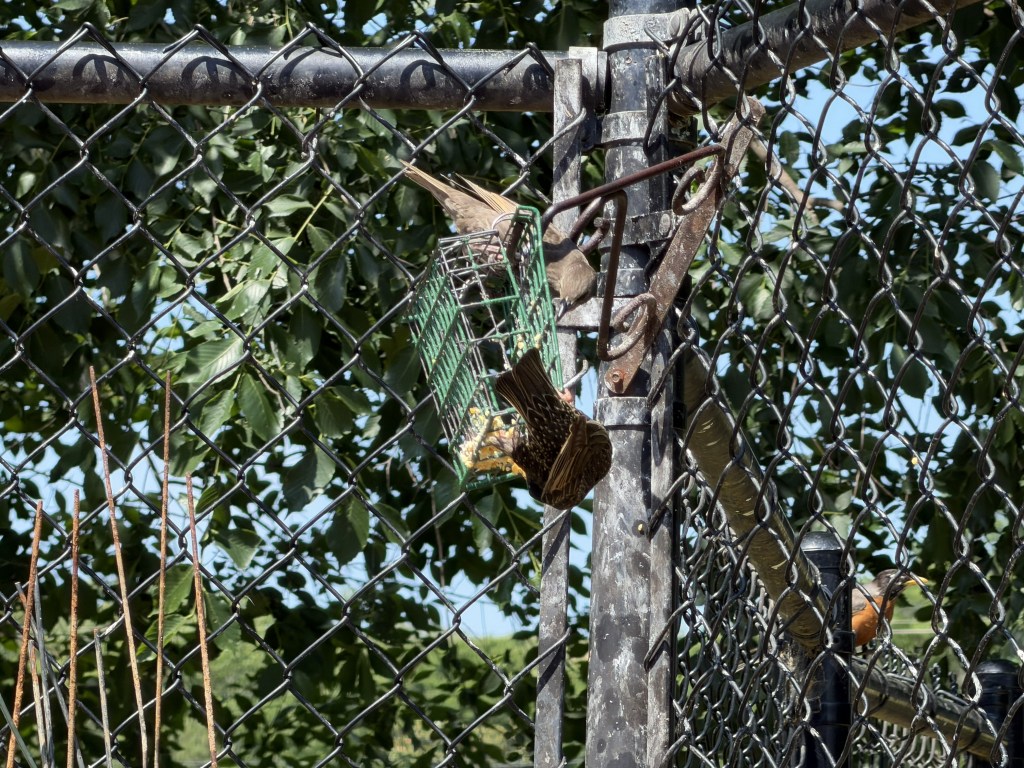
Several days ago, I saw what I thought to be a new bird species in my feeders. This grey bird was about the size of a robin but was busy feeding on the suet cake I had placed on the back fence. I was able to snap a photo and then checked the picture against my Google identification app (I find it easier than either my Audubon or Nat Geo birding apps). I was surprised to learn this was an immature Eastern Starling. This morning Melissa called my attention to this same strange bird she had seen feeding on the suet. She was surprised as an adult starling was collecting seed from the suet cake and feeding it to the larger brown bird. She sent me a picture of the two and I recognized the speckled white feathers of the (springtime) adult and the brown feathers of the immature offspring. Both the parent and young were in different stages of plumage transition.
When I went online, I found the European starling (Sturnus vulgaris), also known as the Eastern Starling, undergoes dramatic feather color changes annually. They transition from a spotted winter plumage to glossy, iridescent black in spring. Juveniles are drab brown, transitioning to speckled, then glossy adult plumage over their first year. Juveniles transition from Summer to Early Fall. Freshly fledged (kicked out of the nest) juveniles are plain grayish-brown or dusky brown with a dark bill. From late Fall to Winter the immature birds undergo a post-juvenile molt and then gain iridescent black feathers that are heavily speckled with white and cream-colored spots. Breeding or adult have the same speckled winter colors and during Spring to Summer experience “wear,” as the white, brittle tips of the winter feathers break off, leaving a glossy, iridescent dark plumage (green, purple, and blue) with a yellow bill. This unique “wear molt” allows the starling to change its appearance completely without the high energy cost of growing new feathers in the spring.
After rousing, I came outside to sit and watch the feeders with Melissa. She has been sending me interesting pictures of a variety of birds in the last several days. It appears Melissa has been coming outside around 8:30 am for her morning coffee and has seen a flurry of activity on the feeders. This morning the female eastern bluebird (Sialia sialis) was bringing newly procured bugs to the bird house on the pool deck. Her arrival was met with the raucous sound of several young vying for a meal. There was also a second sighting of an orange bird about the size of an American robin (Turdus migratorius) feeding on the suet. This time she was able to take a photo before the bird quickly flew away. Although the bird was partially blocked by a starling fighting for the same cake, it appears to have been a Baltimore oriole (Icterus galbula). Melissa said she goes inside around 11:00 am as the “cool” birds are gone by then and it becomes a fight between the northern mockingbird (Mimus polyglottos) and the common grackles (Quiscalus quiscula). It is only recently the starlings have been present at the 11:00 am transition. I need to get up earlier to see the show.
THOUGHTS: After the 11:00 am transition Melissa went back inside. Lately, the temps are warming up, and the sun has been breaking through the overcast sky by this time. I had re-stocked the feeders when I came out and even knowing I had missed the real show, I decided to stick around and see what might transpire. The mockingbird was making a back-and-forth trip to the meal worms, and I wondered if it was also feeding young. The suet cake was descended upon by a group of six starlings, including two pairs of adult and young feeding at the cake together. This is the time of year where birds transition from the nest to fledgling on the ground to joining parents to learn to feed themselves. Humans go through a similar transition, but it takes a dozen or more years and it literally takes a village to do it right. We need support and not criticism. Act for all. Change is coming and it starts with you.

