
May 26, 2026
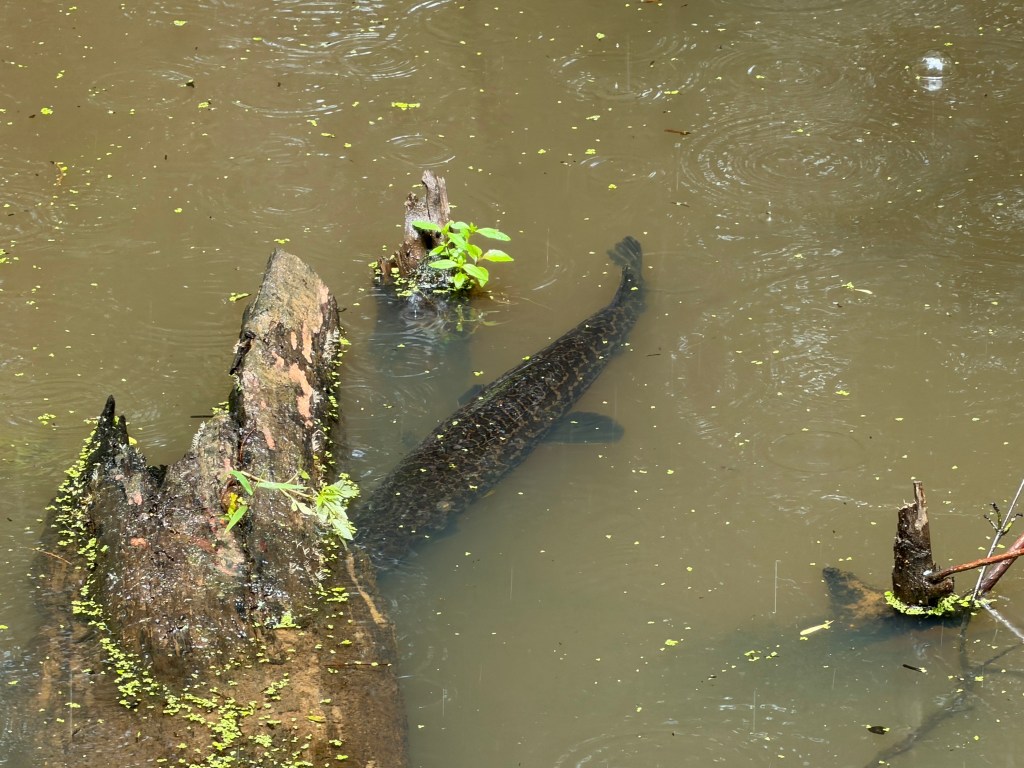
Last Friday Melissa and I decided to treat ourselves to a visit to a Wildlife Management Area (WMA) along the Arkansas River that has been getting constant sightings on the Arkansas Birders group. The area is not too far from our house, and I had even visited once before while looking for a place to fish. We did several errands on our way out of town and by the time we were leaving rain had started to fall. By the time we reached the WMA the rain was light but steady. The last section of the road was dirt but well maintained. This area in an old oxbow (curve) that has formed a lake apart from the main channel of the river. The WMA now has 2,180 acres (882 ha) and is primarily managed for migratory waterfowl and wetland restoration by the Arkansas Game and Fish (AG&F) Commission and Ducks Unlimited. This makes the site popular destination for local hunters and bird watchers. Despite all the amazing bird photos we had seen, we saw very few birds. The waterfowl that had been present when I last visited were non-existent (afraid to get wet?) and there were no birds fliting in the trees. As we drove slowly through the area we crossed over a bridge on a backwater section of the lake. I stopped because there were dozens of 1-pound (0.92-l) gas canisters floating in the water. Next to a sunken log in the bayou was a 30-inch (76 cm) snakehead.
When I went online, I found the northern snakehead (Channa argus) is a species of snakehead fish native to temperate East Asia, in China, Russia, North Korea, and South Korea. Their natural range goes from the Amur River watershed in Siberia and Manchuria down to Hainan, China. Snakeheads are an important food fish and one of the most cultivated in its native region, with 562,179 tons (510,000 tonnes) annual production worldwide. This has led to the fish being exported throughout the world and has resulted in established non-native populations in Central Asia and North America. The species has a long dorsal fin with 49 to 50 rays, an anal fin with 31 to 32 rays, a small, anteriorly depressed head, eyes above the middle part of the upper jaw, and a large mouth extending well beyond the eye. The small, slender teeth form velvety bands (villiform) with large canines on the lower jaw and upper mouth plate (palatines). It is generally reported to reach up to 3 feet 3 inches (100 cm) in length, but specimens approaching 4 feet 11 inches (150 cm) are known according to Russian ichthyologists (fish scientists). The largest specimen registered by the International Game Fish Association weighs 21 pounds 0 ounces (9.53 kg). In the US, it is found in Pennsylvania, Virginia, West Virginia, Delaware, Maryland, North Carolina, Arkansas, Missouri, and Mississippi.
The northern snakehead first appeared in US news when a fisherman discovered one in a Maryland pond in 2002. In 2008, the fish was found in drainage ditches in Arkansas because of a commercial fish-farming accident, and flooding may have allowed the species to spread into the nearby White River which would allow an eventual population in the Arkansas and Mississippi Rivers. Arkansas is the birthplace of warmwater aquaculture in the US and currently ranks as the second-largest aquaculture-producing state. It is also the epicenter for the four species of invasive Asian Carp (Hypophthalmichthys molitrix, Hypophthalmichthys nobilis, Ctenopharyngodon Idella, and Mylopharyngodon piceus). The invasive snakehead can now be added to the list. All five species are said to be quite edible, but getting the American palate to try the fish is a harder sell.
THOUGHTS: AG&F says if you encounter the northern snakehead, silver, bighead, or black carp, kill it (humanely) and report your encounter to the Arkansas Game and Fish Commission Aquatic Nuisance Species coordinator by email (reportans@agfc.ar.gov). It is illegal to transport these fish species alive. While I did not catch the snakehead, I did report it. Invasive species may never be eradicated, but with help they can be managed. Act for all. Change will come and it starts with you.

