
June 21, 2026
I have mentioned our two flower beds dedicated to wildflowers. The one on the north side of the house has sunflowers (Helianthus annuus) and cone flowers (Family, Asteraceae), while the east bed has a self-propagating mix of wildflowers (the package literally said, “wildflower mix”). These beds attract a variety of bees (Clade, Anthophila) and butterflies (Family, lepidopteran). Attached to one of my browsers was an ad asking for my support for local pollinators. The ad described how honeybees do little of the pollination for gardens and orchards. Honeybees (genus, Apis) produce honey, which along with their brightly colored yellow and black bodies make them attractive. They also form colonies (hives) that are often located around orchards or even transported as rentals for pollination. What I did not know until I opened this ad was that 90% of pollination is performed by a solitary bee known collectively as mason bees.
When I went online, I found a mason bee refers to bees in the genus Osmia (Family, Megachilidae) who derive their name from the habit of using mud or other “masonry” products in constructing their nests. These nests are made in naturally occurring gaps such as cracks in stones or other small dark cavities. Some species preferentially use hollow stems or holes in wood made by wood-boring insects. Over 300 species are found across the Northern Hemisphere, but most occur in temperate habitats of Europe and Asia (Palearctic) and North America (Nearctic) and are active from spring through late summer. Osmia species are frequently metallic green or blue, although many are blackish and at least one is rust-red. Most have black ventral masses of black hairs on their hind legs (scopae) which are difficult to notice unless laden with pollen. Two species of the genus, the orchard mason bee (Osmia lignaria) and the blueberry bee (Osmia ribifloris), are native to the Americas, although the orchard mason have been moved from their native ranges for commercial purposes.
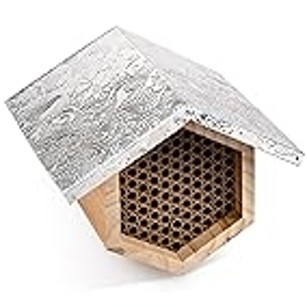
If you want to make your garden an inviting and safe space for the mason and other solitary bees, avoid cute, shallow decorative models. Instead look for removable paper or cardboard tubes or wood laminate trays. If bees nest in drilled in solid blocks, the house becomes a trap for diseases and mites after a single season. The holes should be exactly 5/16-inch (8 mm) in diameter and at least 6 inches (15 cm) deep. If the holes are too wide, bees cannot build secure mud partitions. If the hole is too shallow, the female bees may only produce male eggs. Solitary bees are sensitive to chemicals, so choose natural, untreated, or wood like cedar or pine. Choose a sloped or overhanging roof (metal) to prevent rain from rotting the tubes, and a wire mesh on the front to deter woodpeckers. The house should face southeast or east to receive early morning sun to warm the bees, encouraging them to start pollinating. The house should be attached to a solid surface about 5 feet (1.5 m) above the ground. I ordered one and got another for my grandchildren to enjoy, as well as the bees.
THOUGHTS: The mason bee house in the ad told of a 70-year-old man retiring after 50 years and this would be his last bee houses. The ad pointed out the advantages of purchasing this house and its superiority over the commercial houses online or in stores. It also said there were only 200 houses left. I generally look elsewhere online to see if the “steals” offered by such sites are real and how they compare with other prices. I had a red flag at “200 remaining” at a cost of “only US$69”. My search pulled up a reference to possible scams. When I looked, my ad fit the criteria. The price was twice as much as other houses and did not meet the criteria listed among the “10 best”. There are times we see a great idea that fits a criterion and we buy impulsively. Even if this is the best deal, it should be checked. Otherwise, we set ourselves up to be scammed. That is true regardless of age. Act for all. Change will come and it starts with you.
 A travelers odyssey