
July 17, 2026
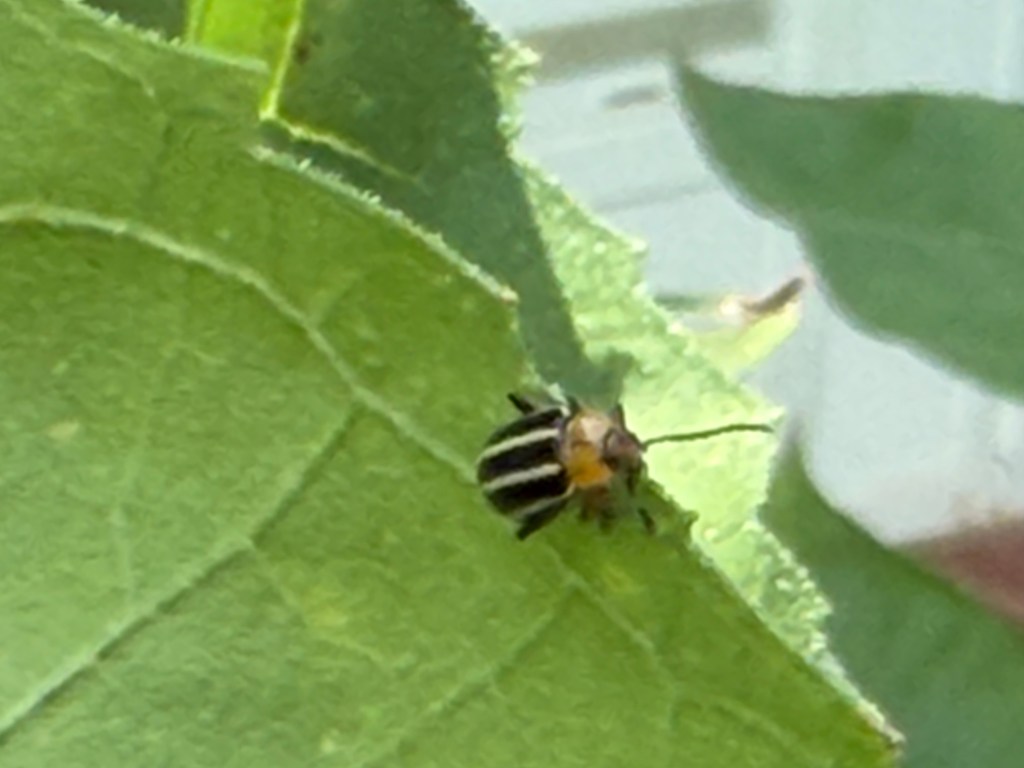
Several days ago, I mentioned my battle with insects in our garden and flower beds. I have overcome the squash bugs (Anasa tristis) this year, but the vines rotted before I got much fruit. I only found a few bugs on my squash, but I finally located squash vine borer moths (Melittia cucurbitae) on my sunflowers. The vine borers lay their eggs on the underside of leaves and when the larva hatches, they bore into the vines and can cause them to rot. That seems to be the clear case for my squash (genus, Cucurbita), but it did not account for the pitting I saw on the red amaranth (Amaranthus cruentus) leaves in the bed. I have been checking the plants daily for any moths and the underside of the leaves for eggs, capturing the moths (if possible) and scrapping the eggs off the leaves. If the leaves have already been discolored, I am cutting them from the plant. My close early morning inspections proved fruitful today as I spied another beetle on one of my sunflower leaves. When I checked it was identified as a pigweed flea beetle.
When I went online, I found the pigweed flea beetle (Disonycha glabrata) is a species of striped flea beetle in the family Chrysomelidae. This small, striped leaf beetle is known for skeletonizing plants in the Amaranth family (like it did mine). Plants in the amaranth family may be called pigweeds because they were/are used to feed pigs. The flea beetle is active in gardens and fields during the summer, chewing tiny round holes and laying eggs on the leaves. The larvae spend their first 13.5 days in the soil before crawling out as adults. The Pigweed Flea Beetle has a red and black head. The red, shield-like part on an insect’s body (pronotum) has a black dot in the center, or may have three black dots, depending on the individual. The black wing coverings (elytra) have four yellow lines on them, with the two on the left connecting at the bottom as do the two on the right. Antennae are black, and legs are red and black. Other members of the same genus have a similar appearance, but the width, color, and number of the lines on the elytra differ between them.
The pigweed flea beetle is active from late spring through autumn and is not considered a significant pest in a backyard garden. That is unless you are trying to grow red amaranths. It is best to use a multi-step approach to control and manage infestation. Start by placing fine Floating Row Covers over young plants immediately after planting to block access. Once plants are established, spray them with organic Spinosad or Neem Oil. These sprays must be applied in the early morning or evening and directly contact the beetles to be effective. While Neem Oil is considered organic, spraying in the evening eliminates possible contact with the pollinators who would also be harmed by the oils. Flea beetles are highly attracted to plants like radishes or hemp and planting these near your valuable crops creates sacrificial targets that can be easily treated or vacuumed. Flea beetles locate food by smell and interplanting strongly scented herbs like mint (Family, Lamiaceae), basil (Ocimum basilicum), or catnip (Nepeta cataria) can confuse the pests. This would also make our neighborhood cats happy. Tilling the soil in the fall and removing garden debris helps destroy overwintering adults and larvae hidden in the topsoil.
THOUGHTS: Finding the pigweed flea beetle solved another riddle from my garden. Last year it was the pock marked squash leaves (squash beetle), and this year it was the rotted vines (squash vine borer) and skeletonized amaranth (flea beetle). I have found knowing the cause does not resolve the problem. You also need to take appropriate (and specific) action. This is where listening to science and experts can be invaluable. Otherwise, you risk wasting time and money, and sometimes your integrity. Act for all. Change will come and it starts with you.
 A travelers odyssey