
August 26, 2026
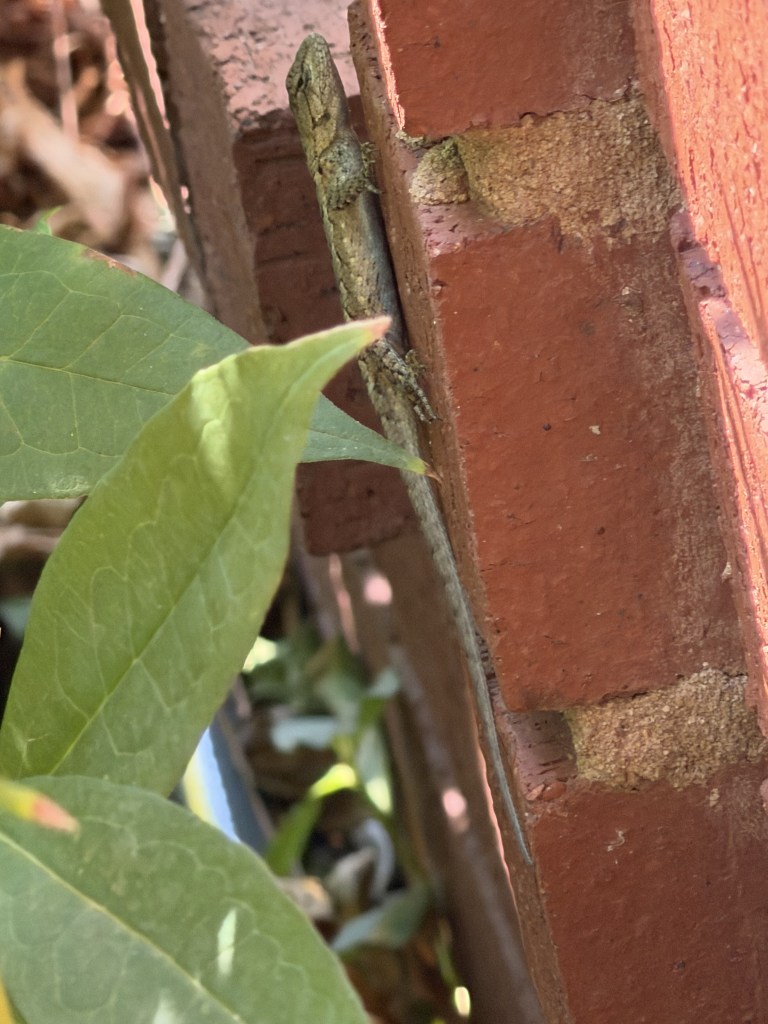
I started late this morning and the “feels like” temperature was already 101F (38C), so even the shaded park path seemed too much for the kids (and me). I knew the brief rain we got last night was not enough to keep my seed damp in the sun. The sparrows (Passer domesticus) and finches (Haemorhous mexicanus) scattered as I walked onto the pool deck to fill the feeders and give my plants a shot of water. The birds had attacked several of the tomatoes (Solanum lycopersicum) I was letting ripen on the vine, so I picked the ripe fruits (about 20) along with 10 red jalapenos (Capsicum annuum). Next, I went out to give the seeds in the raised bed a good drink. As I walked back to turn off the hose, I caught rapid movement across the sidewalk and then the mulch near the faucet. I stopped and caught another quick movement up the wall. Hidden on the wall and covered by the phlox (Phlox paniculata) was an eastern prairie lizard.
When I went online, I found the eastern prairie lizard (Sceloporus consobrinus), also known as a fence lizard, is a species of lizard in the family Phrynosomatidae. Distribution in the US extends from far western Nevada east to New York and from southern South Dakota in the north into Mexico to the south. Prairie lizards can be distinguished by the combination of highly keeled, pointed, and overlapping scales; no “horns” at the back of the head; and a tail longer than the body. Coloration and pattern can be highly variable, even within local populations. The top (dorsal) coloration can be gray, brown, or a mixture of gray, brown, and white, and chevron-shaped lines can be present or absent and may have a distinct gray stripe along the midline of the dorsal body surface. Lighter stripes may be well to poorly defined on lateral body surfaces extending from the neck to the first one-third of the tail. Adult males have distinct green-blue patches bordered by black on each side of the under (ventral) body surface. In larger males, the underside of the jaw may be black with green-blue patches on either side of the throat. Prairie lizards reach just over 3 inches (7.5 cm) in snout-vent length (plus tail) while hatchlings are about three-fourths of an inch (2 cm) in snout-vent length.
Prairie lizards can be active during any month of the year if temperatures are high enough but are most active during March to October and are found in almost every terrestrial habitat. The color and pattern variations (ectomorphs) are often associated with the microhabitats where they live. During the breeding season (late spring to early summer), males are territorial and aggressively interact with other males. Females deposit clutches of 6 to14 eggs from early May through July and may deposit more than one clutch per season. Eggs are deposited in shallow burrows in the ground, under surface objects, and possibly in the walls of mammal burrows. There is no parental care. Eggs hatch from late July through September. Lifespan under natural conditions is unknown but individuals (likely) can live up to four years. These lizards are “ambush foragers” and eat a variety of insects. They rely on relatively high body temperatures (about 95F/35C) for activity and are often observed basking in direct sunlight. Their primary defensive behavior includes a combination of camouflage (crypsis) and short, rapid retreats to crevices, shrubs, or other safe harbors once they have been detected.
Thoughts: The Prairie lizard can be observed by remaining still for 5 to10 minutes in their habitat and watching for movement. I watched for about 1 minute trying for a better photo and it never moved. Not moving is not always a good strategy. Warm-blooded predators (dogs and bears) see your body heat and the sound of breathing can be picked up by ears. Animals with a strong sense of smell (like dogs) find you by the air. Humans instead make loud noises and band together in packs. It helps that we are at the top of the food chain. Act for all. Change is coming and it starts with you.

