
July 31, 2026
This week I tore out the last of the plants in my raised beds. The first to go were the remaining onions (Allium cepa) I had left in the ground. I found it was a mistake to leave the mature bulbs in the ground as the sun and high temperatures (95F+/35C+) burned the tops of the bulbs that stuck out of the soil (another learning experience). It became clear the cabbages (Brassica oleracea) were done forming into heads and were just soaking up water. I joked with Melissa that I had raised “tiny cabbages”, my cutesy name for brussels sprouts (also Brassica oleracea). They came out, and the small heads are waiting in the vegetable bin for me to do something with. The volunteer cantaloupe (Cucumis melo) only produced two viable fruits and there were no new flowers, so out it came. The last to go were the two cucumber plants. They had produced well, including 14 pints of canned dill pickles and numerous pounds to donation. Now I need to prepare the beds and get ready for my fall planting. Thinking about what goes where always puts me on alert, so my interest was perked when I came across a Facebook reel touting the virtues of Electroculture Gardening.
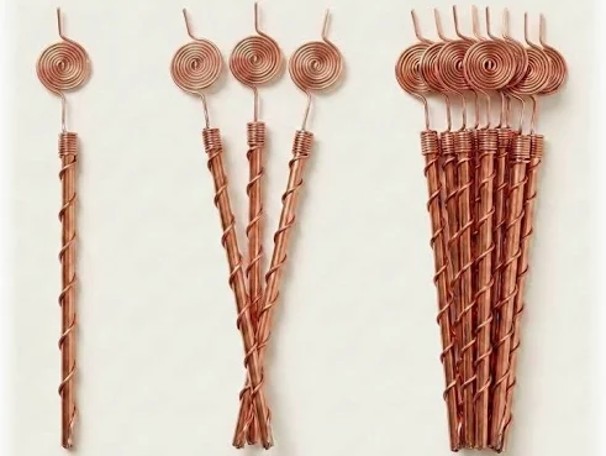
When I went online, I found electroculture gardening is an alternative practice involving placing copper wires, antennae, or magnetic coils into the soil to capture atmospheric and geomagnetic energy. Proponents of the technique claim it accelerates growth, increases crop yields, and repels pests. Mainstream science views these claims as lacking “robust” empirical proof. The copper antennas are simple enough to make and are readily available for purchase. They consist of copper wire wrapped tightly around an 11 inch (37.5cm) wooden or bamboo stake that is then pushed about 3 inches (7.5 cm) into the soil. In the Northern Hemisphere you twist the wire in a clockwise spiral to supposedly match local magnetic forces. You can also place open loops of copper wire (Lakhovsky-style coils) around the bases of individual plants. This coil is a simple open-ended loop of wire with overlapping ends that do not touch, invented by Georges Lakhovsky, to act as a passive resonant circuit. Controlled tests and academic agricultural reviews find no verified mechanisms or consistent data showing that passive copper wire acts as an effective power antenna or nutrient booster for soil, and suggest standard alternatives (organic compost, maintaining proper hydration, and rotating crops) work as well or better to improve harvest.
I have tried several trendy methods to grow or increase the produce in my yard. This includes raised beds using hügelkultur (built over logs), cloth grow bags, the three sisters (corn/ Zea mays, beans/ Phaseolus vulgaris, and squash/ genus Cucurbita) grown in mounds, 5-gallon (19 L) buckets, and containers. I even have gone so far as to plant directly in the ground (ha ha). All these methods have been successful at times, and at other times not. I am constantly trying to increase yields to make our household more sustainable and less dependent on outside resources. I have yet to be consistent.
THOUGHTS: Electroculture gardening seems to be another attempt to improve crop yield. Some have made a stark claim that the world only has a limited number of harvests left (100, 60, or even 30). While the claims are overblown, soil erosion rates from across the world span five orders of magnitude. Around 16% of the world’s soils are eroding quickly and have an estimated lifespan of less than 100 years. Half of the soils are eroding slower with a lifespan greater than 1000 years while one-third have over 5000 years. As with my garden, we need to protect our soils with agricultural practices like cover cropping, minimal to no tillage, and contour cultivation. While it is feasible for me to test electroculture, extending the world’s soil will require a proven and cooperated effort across every country. Act for all. Change will come and it starts with you.

