
September 25, 2026
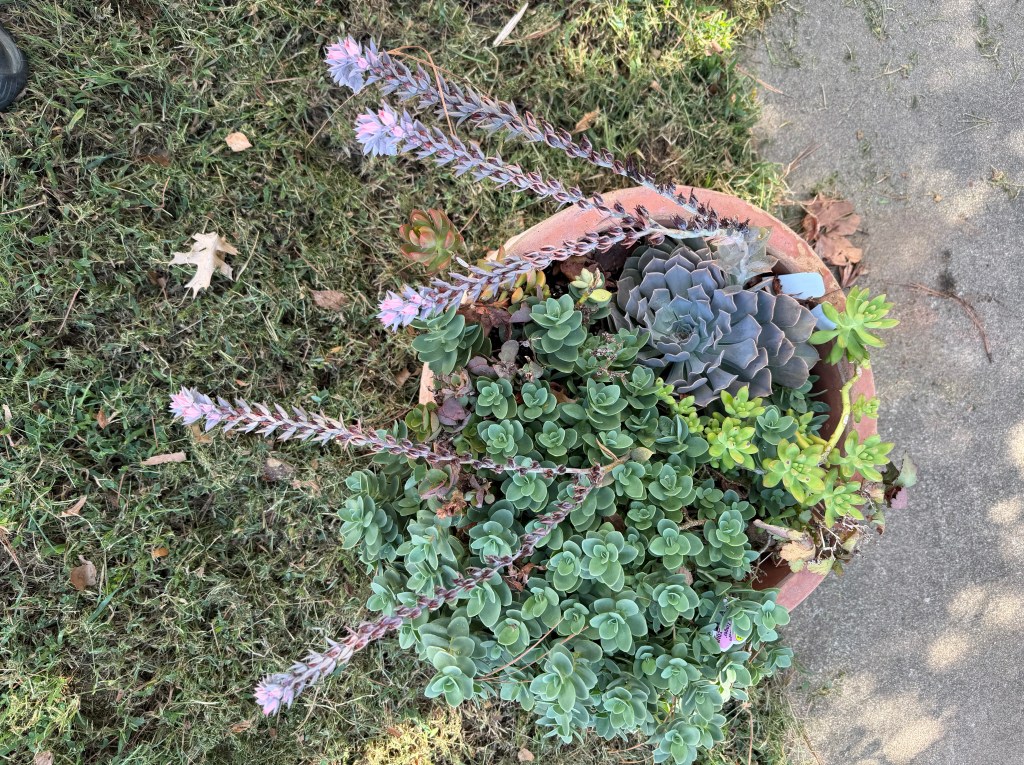
Melissa has tried to cultivate several varieties of succulents in the front flower bed under the Japanese Maple (Acer palmatum). Melissa’s mom had grown flowers in the bed, but we tried to transition it into a succulent garden. That meant placing around 8 square yards (6.7 sq m) of landscape pebbles to provide better drainage. Not one of the succulents survived beyond their first winter. Her mom’s flowers are still coming up so we gave up and turned the area back into a flower bed. This year Melissa took another tact. Instead of planting in the bed, she planted arraignments of various succulents in containers, and I dug in pavers for them to sit on. The thought is we will move the pots to the porch during the winter so they will continue to stay alive. These arraignments are in full sun most of the day and the plants seem to be thriving. One large pot has a mixture of October daphne stonecrop (Sedum sieboldii) along with a hen and chicks’ variety. Melissa has had this plant for several years and its new location has triggered the ghost echeveria to produce its first bloom.
When I went online, I found the ghost echeveria (Echeveria lilacina), or Mexican hens and chicks, is a species of succulent plants in the genus Echeveria belonging to the family Crassulaceae. The genus name Echeveria was given in honor of the 18th century Mexican botanist and painter Atanasio Echeverría y Godoy who is famous for his paintings of plants, many of which were included in Flora Mexicana. Lilacina means ‘lilac-colored’. The species is native to Nuevo Leon, in northern Mexico and thrives on rocky areas at quite high elevations. The center (rosette) can reach a height of about 6 inches (15 cm). The leaves are silvery-grey, spoon shaped, fleshy and arranged in a symmetrical rosette 5 to 10 inches (12 to 25 cm) in diameter. This is a slow growing plant that is drought tolerant. The flowers are pale pink or coral colored and emerge on small, short arching clusters (racemes) on the top of reddish stems about 6 inches (15 cm) long. The normal flowering period extends from later winter to early spring.
Melissa also added a dash of Palmer’s stonecrop (Sedum palmeri) to the pot of October daphne stonecrop and ghost echeveria. This adds a height difference to the low daphne and the rounded ghost. Sedum palmeri is another species of stonecrop from Mexico. It is a highly variable species with multiple branching stems and rosettes of thick, spoon-shaped, grey-green leaves with pointed tips. Sedum palmeri typically grows in the northeastern region of Mexico, particularly in the Sierra Madre Oriental, north of the Guayalejo River, spanning areas of Tamaulipas, Nuevo León, and Coahuila. By contrast, the daphne is native to Japan. All three species are widely grown as ornamental plants.
Thoughts: Part of the enjoyment of growing plants from around the world is being able to mix and match difference species that would never have been associated in the wild. The Ghost and the Palmer’s are both native to the Nuevo Leon area, but the daphne is from Japan, but together they produce an esthetic compliment. The ghost is slow-growing and slow blooming plant but seems to be doing well in their sunny container pot. The US has long been called the melting pot of the world. While each new nationality was initially seen with distrust (Irish, Germans, Asians, Southern Europeans, Africans, Latins), They are said to have melted into the uniqueness that is the country. This is not a bad thing. It is our strength. Act for all. Change is coming and it starts with you.

