
September 30, 2026
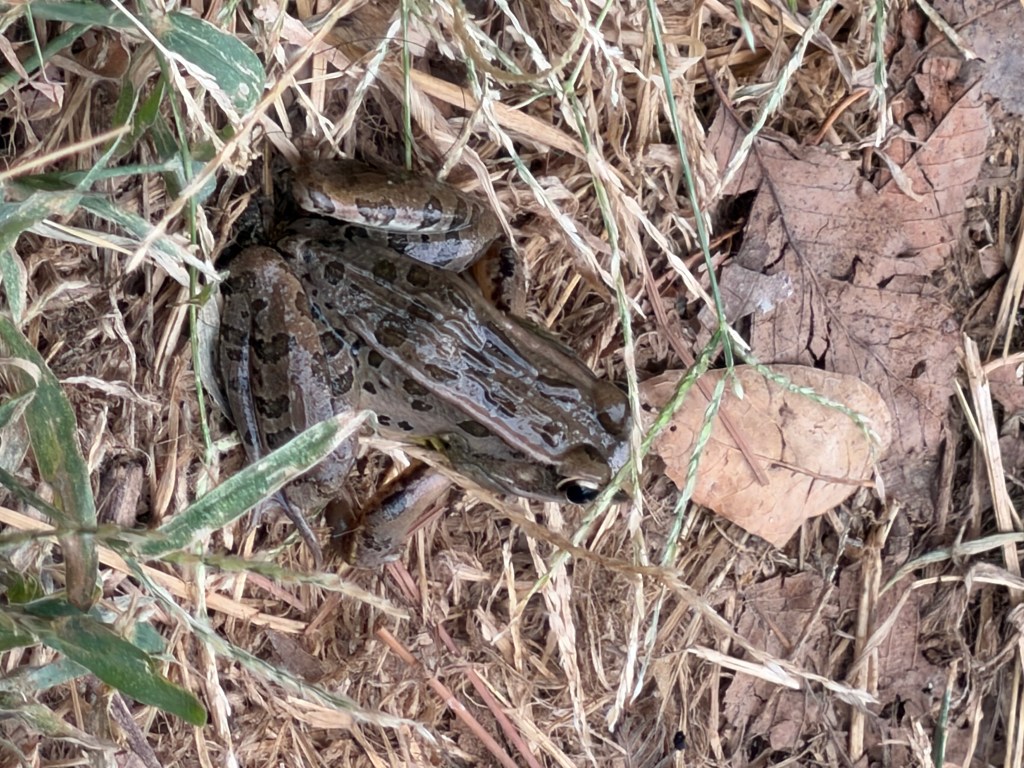
I have mentioned how Loki is now on constant lookout when he first goes into the backyard. He jumps down and sniffs both sides of the exit ramp before moving on to grass beneath the bay window. Next, he moves on down the house to the storage box next to the vegetable bed. He has good reason to be frantic as several times he has almost caught the Woodland Vole (Microtus pinetorum) that lives under the ramp and feeds off the seeds dropped out of the feeders by the birds. This morning Loki was so intent on sniffing the ramp he failed to notice the house mouse (Mus musculus) that scurried across the cement deck and down a hole next to the pool. I went over to replace the window feeders I take down every night to discourage the raccoons (Procyon lotor) return and notice movement at my feet. When I looked down, I saw a different species of frog. This was not the gray tree frogs (Hyla versicolor) or the American bullfrogs (Lithobates catesbeianus) that croak during breeding season. This was another common resident, the southern leopard frog.
When I went online, I found the southern leopard frog (Lithobates sphenocephalus) is a medium-sized amphibian (anuran) in the family Ranidae (true frogs). The species is one of 36 species currently or formerly classified in the Rana genus found in North America. It is native to eastern North America from Kansas to New Jersey to Florida and is an introduced species in some areas (California). Individuals are up to 5.1 inches (13 cm) long. Mature males average 2 inches (53 mm) snout to rear (vent) length and females average 2.5 inches (64 mm). The leopard is green or brown in color, has a yellowish ridge along each side of the back, rounded dark spots on the back and sides, and a light spot on each ear (tympanum). The male has larger fore limbs than the female. A breeding male’s vocal sacs are spherical when inflated with a “ratchet-like trill” or “chuckling croak” for a call.
I had just enough time to snap a photo of the leopard frog before Loki continued his search along the back of the house. As Loki approached the bay window, the frog took note and began to hop away. That alerted Loki to the frog’s presence and he rushed after it. The leopard frog was fast and hopped into the red canna lilies (Zantedeschia rehmannii) that dominate the center of the area. Now lost in the foliage, Loki could only snuffle back and forth with a soft whine. I did not mind the presence of the southern leopard frog as they feed primarily on insects, crawdads (Procambarus clarkii), and other invertebrates. Our pool has long shrunk in size during the summer heat and no longer supports the gray treefrog tadpoles that teemed there this spring. The leopard moves away from the water during the warmer months and is away from water most of the time as they forage in upland areas. This is a welcome addition to help clear pest from my garden and containers.
Thoughts: While the leopard frog is common to our area, this is the first one I recall seeing in our back yard. Our pool/pond is not conducive for breeding, and I have never seen the egg clusters that float among the low foliage where they like to breed. Since there was only one frog, I assume it was foraging away from its water source, probably the Crooked Creek about 400 yards (366 m) to the south. The eggs masses can hatch from 4 days to two weeks and hatch more quickly in the presence of predators like crayfish. That means crawdads eat leopard frog eggs that grow to feed on small crawdads. This is part of nature’s irony. Humans need to be more observant of our earth mates and learn about how diversity drives us all. Act for all. Change is coming and it starts with you.

