
November 16, 2026
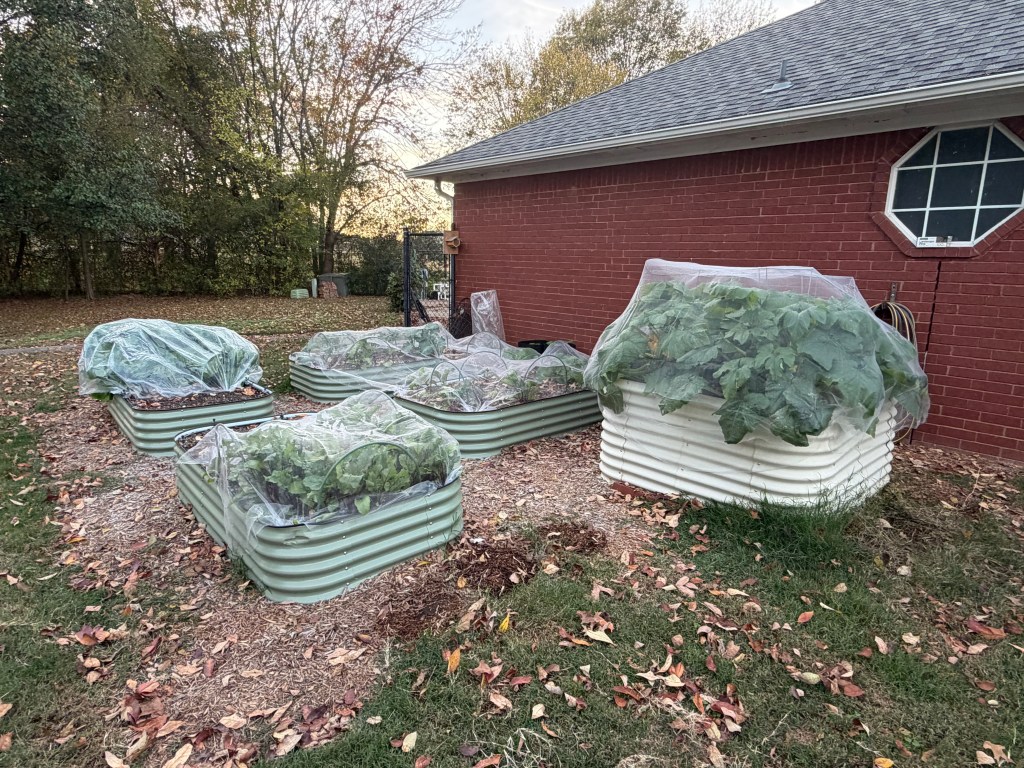
We have finally reached the time of year when I must guard our plants against the cold. Melissa and I both spent most of the day Thursday preparing for the drop in temperatures predicted over the weekend. Melissa places her cactus (Family, Cactaceae) and many of her succulents (various Families) on outside racks during the summer months. The plants had been enjoying the sun even as the temperature dropped to the 40+F (4.5+C). We moved a large rack inside and moved all the plants onto the back sun porch for the winter. I still have straightneck squash (Cucurbita pepo), and the last of the beets (Beta vulgaris) and turnips (Brassica rapa subsp. rapa) in the raised beds. The beds also have 10 broccoli (Brassica oleracea var. italica) plants I am trying to produce before things get too cold. The six wax beans (Phaseolus vulgaris) are bushing but far from producing yet. Then there are still ten tomato (Solanum lycopersicum) plants loaded with green fruit and my six jalapeño (Capsicum annuum) plants that are in various stages of ripeness. I covered the raised beds, moved the peppers against the house wall and covered them, and brought the beans inside the porch. The tomatoes I left to fend for themselves. We were ready for either frost or freeze.
When I went online, I found the difference between frost and freeze in relation to outdoor plants. Frost is the formation of ice crystals on surfaces when moisture freezes, while a freeze is a meteorological event when the ambient air temperature drops to 32F (0C) or lower. Frost can occur even when air temperatures a few feet above the ground are slightly above freezing or around 33F to 36F (0.55C to 2.2C), due to heat radiating off the ground on clear, calm nights. Frost occurs as water vapor goes directly from a gas to solid ice crystals and forms on leaves, grass, and objects causing damage to tender surface foliage, tip browning, or fragile seedlings. A freeze occurs when the actual air temperatures of 32F (0C) or lower across a broader layer of air. This is brought on by a cold air mass or wind (advective freeze). A freeze may or may not produce visible frost crystals depending on humidity but causes the water inside plant cells to freeze causing cell walls to rupture. Leaves and stems then turn water-soaked, limp, and black or brown as they thaw.
We did receive a frost on Saturday and Sunday mornings. This did cause some wilting on everything outside and I lost one of the uncovered tomatoes. I was surprised how well the outside plants held up. The temps during the day rose to 50+F (10+C) so they were all able to recover during the day. It is predicted to have highs in the 60F’s/40F’s (15+C/4.5+C) to 70F’s/50F+ (21+C/10+C) for the next eight days before dropping back into the 50’sF (10+C) again. I have a friend who would like the rest of my beet tops so I will pick them on Saturday. I plan to also pick the turnips regardless of their size as I am afraid if I leave them any longer, they will get stringy. I should also have a large crop of jalapeños and squash. After that I will shut my outside garden down and shift toward preparation for the Spring planting. This time I am going to use new seeds. Every year is a learning experience.
Thoughts: Growing season is defined as the time between the last and first frost. In my area that is between April 3 and November 1, or 211 days. This year it was longer, with the last frost in March and the first frost over the weekend, or an additional three weeks of season. This was mitigated by the 49 days above 100F (37.5C) that stopped any growth during the summer. I remember my Kansas wheat (Triticum aestivum) farmer grandfather saying you could make it if you got one good year out of every seven. Sustainability is a fickle business that is being made even harder by climate change. We need to start working to save the planet. Act for all. Change is coming and it starts with you.

