
November 27, 2026
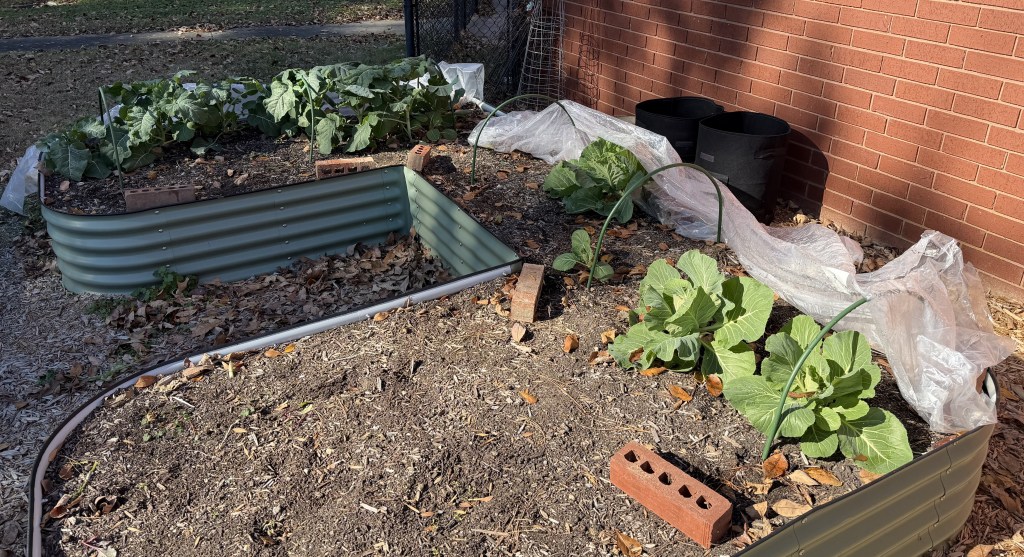
I mentioned we got colder temperatures the last two weeks. That meant the first frost (34F/1.1C), the first freeze (32F/0C), and our first hard freeze (25F/-3.9C). I was not concerned as I harvested or moved most of my vegetables inside, except for one of my raised beds. These plants got a late start and were just now starting to take off. I wanted to see if they could still produce. While I worried about the first frost, I was sure the first hard freeze would kill the leaves. I took care to cover the two rows of plants with plastic to protect them from the cold. I covered them two nights last week until the temps stayed in the 40’sF (4.5+C). Then on Sunday the night temps dipped to a hard freeze and stayed there several straight nights. Nothing in my uncovered flower beds survived. Even the day temps this week remained in the upper 30’sF (1.5+C) so I was cautious and kept the covers on. Nighttime temps are again rising into the 40’sF (4.5+C) and I felt confident enough to set back the covers and let the plants soak in the sun. Since these plants were brassicas, I felt they should do fine.
When I went online, I found broccoli (Brassica oleracea var. italica) and cabbage (Brassica oleracea var. sabauda) are frost-hardy brassicas that grow best in cool weather (60F to 70F/15.5C to 21C) and even handle light to moderate frosts. Most broccoli and cabbage tolerate temperatures down around 24F to 28F (-4.5 C to -2.2 C), and hardy varieties can handle even lower temps if acclimated. Cool temperatures often improve flavor in brassicas and reduce going to seed too early (bolting). Cooler weather also slows down many garden pests that plague summer crops. However, sudden Arctic blasts or prolonged freezes below 25F (-3.9C) common in western Arkansas can damage exposed heads or stems. It is recommended to cover plants with floating row covers, frost cloth, straw, or buckets before the temperature drops. Another issue is consistent moisture to help roots and leaves stay healthy without drying out from cold wind. Finally, the site said to watch for any remaining pests as slugs and aphids can still show up on cool-season greens, so be sure to check the undersides of leaves when you are covering or harvesting the vegetables.
While I knew I had planted brassicas in the raised bed, I was mistaken on what varieties they were. I assumed both rows were broccoli and had been praising their hardiness to Melissa. Melissa had gone and looked at them when they were uncovered last week and realized I had two different varieties, not just one. While there were six broccolis along the back of the bed, the perpendicular row was four cabbages. The leaves are similar and what finally alerted me was the inner leaves of the perpendicular row were starting to curl in to form the cabbage heads. I lost all my broccoli and all except two of my cabbage this Spring. I have been jealously hoarding the two jars of sauerkraut but finally opened one last week for the dinner of kielbasa sausage, sauerkraut, and a baked potato (Solanum tuberosum) that we like so well. Now three of the new cabbaged might have a chance to make it. We are in for cool (not cold) temps for the next 7 to 10 days. I can only hope.
Thoughts: Brassicas are the subject of much scientific interest for their agricultural importance, and six (B. carinata, B. juncea, B. oleracea, B. napus, B. nigra, and B. rapa) have evolved by the combining of chromosomes from three earlier species. The cultivated species of the genus are native to Western Europe, the Mediterranean, and temperate regions of Asia, while many wild species grow as weeds in North America, South America, and Australia. Some people dislike cabbage or broccoli because they contain a phenylthiocarbamide (PTC) like compound, which can be bitter. Others find this tasteless and enjoy many parts of the plants. Food preferences may be cultural or physical. Vive la difference! Act for all. Change is coming and it starts with you.

